AI Systems Architect.
~$1M/month in automated financial operations.
Same framework. Built for your business.
~30 custom agents in production, running real business operations.

Built in production, not theory.
I built AI operations infrastructure inside a fast-growing property management company for years. Payment automation, acquisition pipelines, and onboarding systems ran live across five teams.
That system now powers roughly $1M/month in automated financial operations and anchors the consulting architecture I build for clients.
The system carries context across sessions. What was decided last quarter, which vendor had the issue, which approval pattern your team prefers: none of that needs re-explaining. Governance makes it compound, so each session builds on the last. If you want AI that gains value over time instead of resetting, start with an Audit.
I also build production-grade n8n workflow engines for operations teams of every kind. One-time purchase. No SaaS fees. Your existing AI subs are already costing you enough.
Questions people ask before scoping the build
Short answers, grounded in the actual work. If the fit is still unclear after that, the audit is the cleanest way to look at it.
What do you mean by AI consulting?
Strategy that ends in a build. I look at the actual work, find where AI belongs, and write the scope for what gets built first. If the fit is wrong, you save the cost of building the wrong thing.
Do you only work with CEOs?
No. CEOs are my primary clients, but the work fits whoever owns the operation, not a specific title.
What kinds of systems do you build?
Systems that run operations without you in the middle. Intake, triage, approvals, reporting, and full operating layers built around the tools you already use.
What makes your approach different?
Most AI devs stay on one layer: automations, API integrations, low-code/no-code platforms. My approach already covers all of those, so I only touch them if needed. The default is a full 7-Layer Agent Framework with proven business outcomes.
What do I get from the audit?
You get a written scope document: what to build, in what order, with a realistic timeline and a fixed price per outcome. It also covers what I would skip, the risks I see, and any dependencies that need to land before the build starts. Either way, you leave with a clear answer before spending on implementation.
Do you only build on one model?
Claude is the primary model. The architecture is model-agnostic, so OpenAI, Gemini, or any documented LLM can slot in. Build on what you're already paying for.
Can I see a sample of your code?
Yes. There's a dedicated page of production code samples, each with the full source on GitHub. Browse them at agents.reybenbaquirin.win.
Ready for a real plan? Start your audit.
Services
Every engagement is milestone-gated. You see the work before the next phase starts. The architecture stays governed whether the build is an audit, an automation, or a full agent system.
How pricing works
The audit sets the build price before any work starts. Some scopes come in under $12,500. Complex multi-agent architectures go well beyond.
AI Operating System Build
Stop paying people to do work software should handle. I build the governed layer that connects your agents, memory, approvals, and tools, then deploy it to your infrastructure. You are not dependent on me to keep it running.
This AI Operating System is built on my own 7-Layer Agent Framework.
AI Architecture Audit
You send the problem. I come back with a written scope, a realistic timeline, and a fixed price. The full picture before any build starts, with no obligation to continue.
Not sure where to start? The audit tells you what to build first.
Start Your Audit →I also ship n8n workflow engines
Production-grade n8n automation. One-time purchase. No SaaS fees. Your existing AI subs are already costing you enough.
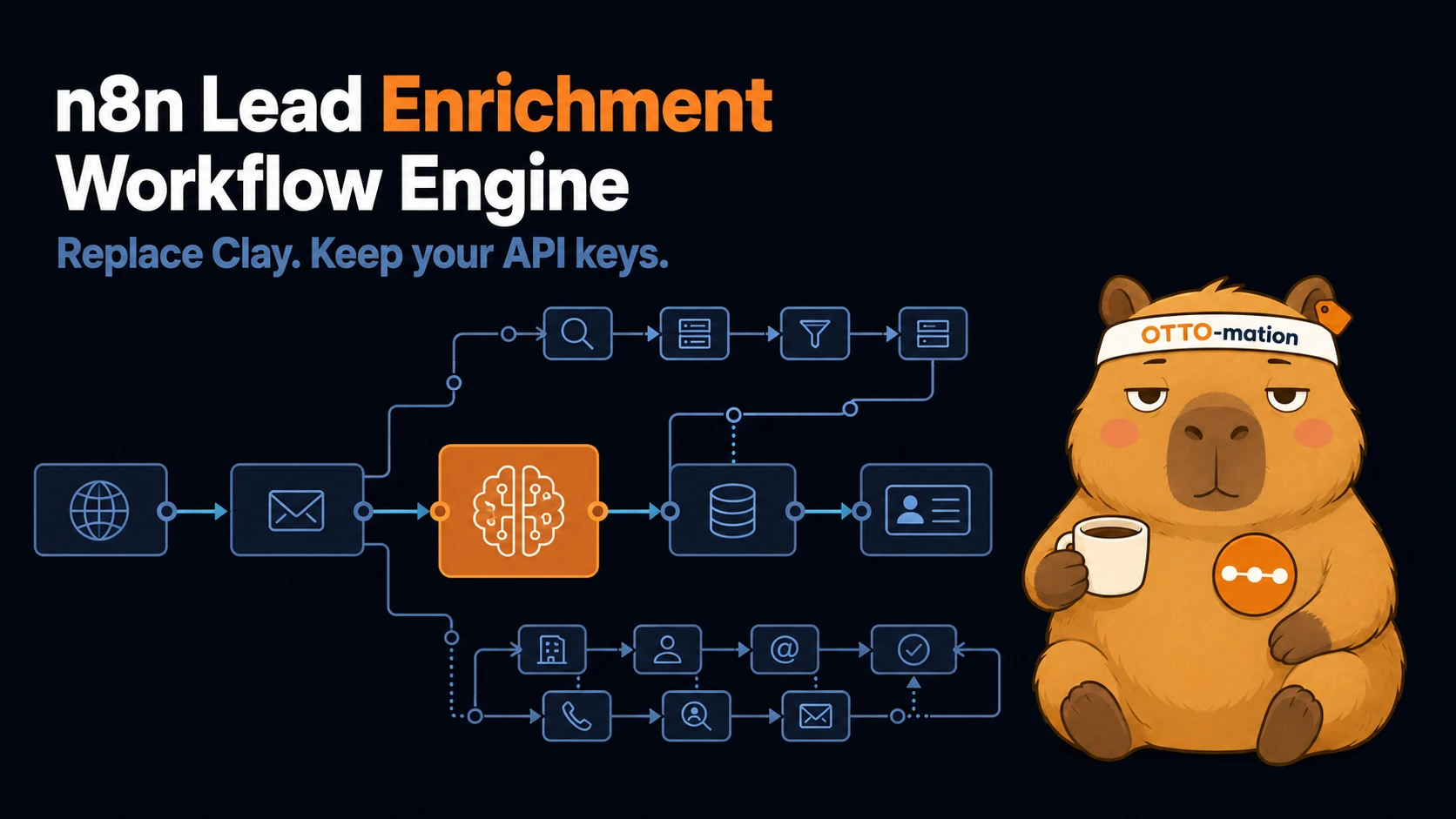
n8n Lead Enrichment Engine
Replaces Clay Growth ($446/mo) with a $499 one-time engine.
Apollo company enrichment, Hunter email discovery, optional Prospeo fallback, Google Sheets output, optional HubSpot write-back, and Dead Letter routing.
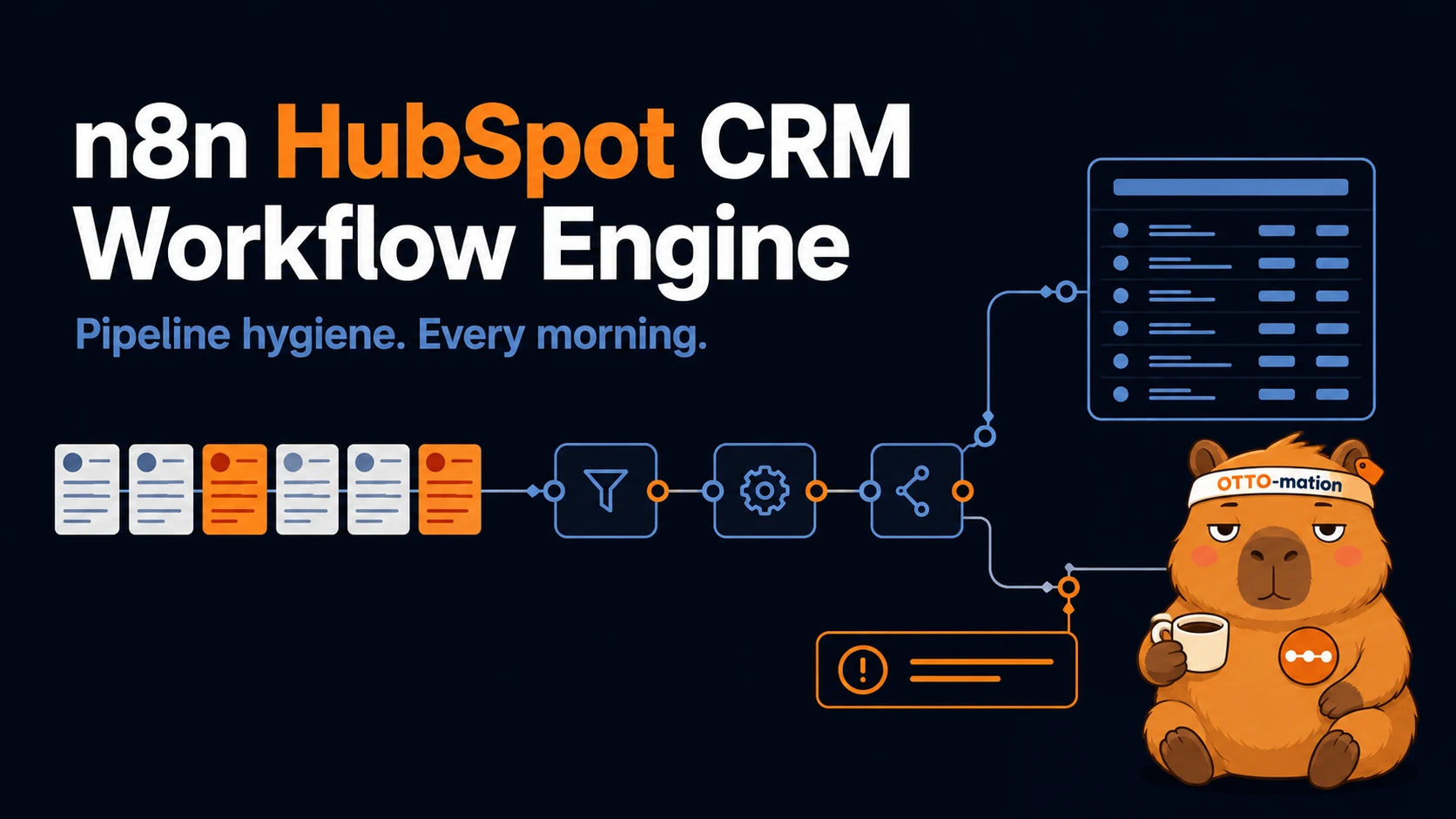
n8n HubSpot CRM Engine
Automates HubSpot pipeline cleanup for $349. One-time purchase.
Finds stale open deals, moves them into a Stale stage, writes per-owner Google Sheets tabs, and sends owner-grouped Slack summaries on a schedule or webhook.
Need one built for your exact stack?
If your workflow needs a different CRM, spreadsheet, webhook, Slack flow, or documented REST API, send the logic and systems involved. I'll scope the build and send back timeline and fixed pricing.
Browse all engines at ottomation.gumroad.com
The 7-Layer Agent Framework
by Rey Benjamin Baquirin
Built in production, not on a whiteboard. Seven layers: governance, reusable skills, hybrid memory, approval gates, second-opinion validation, orchestration, and multi-AI co-residency. The same architecture runs about $1M/month in automated financial operations for a ~300-property short-term rental company.
Two models from different providers review every plan before it ships.
Persona & Role Governance
One file defines what every agent is allowed to do. It sets each agent's role, the tools it can touch, and the context it sees, across all ~30 agents. No code change required.
Outcome: ~30 production agents. One governance layer. No per-agent configuration drift.
Read the architecture
A single governance layer sets the rules every agent runs under: what each one is responsible for, which requests it handles, and the limits that apply across the whole system. Those limits hold no matter which agent is working. The AI cannot quietly rewrite its own rules. Changing the governance layer takes explicit human sign-off, so the system can't drift away from how you want it to behave.
Reusable Skills & Tools
The infrastructure every agent runs on. 32 skills, 6 live hooks, and a 67-file standards library. A new capability slots in without touching the core system.
Outcome: 32 skills. 6 hooks. 67-file standards library. Every agent draws from the same pool.
Read the architecture
The system shares one toolset across every agent: 32 reusable skills, 6 automated guardrails that fire before an agent acts, and a 67-file standards library that holds one quality bar across every project. A capability is built once, and every agent can use it. The guardrails catch problems at the point of action, not after the damage is done, so a single mistake can't quietly spread across the fleet.
Hybrid Memory
Agents that remember what was built and why. 400+ typed, lifecycle-managed memory files organized by project and scope. No manual re-briefing at session start.
Outcome: 400+ files. Zero manual re-briefing. Context carries forward session to session.
Read the architecture
Each agent keeps its own memory, sorted by type: how it should behave, what it knows, and where the current work stands. It loads only what the task needs, so context stays cheap as history grows. One project's memory never bleeds into another. The memory survives a session reset and stays readable by a person, so nothing important has to be re-explained and you can always check what the system thinks it knows.
Plan-Approve-Execute Gates
Nothing consequential runs without a plan and a sign-off. Every change moves through six stages, from the first plan to a final review. You approve at stage three. No stage is optional.
Outcome: Plan-gated. Human-approved. Machine-reviewed before delivery.
Read the architecture
Every change starts as a written plan. You approve that plan before any work begins, so nothing gets built on a misread of what you wanted. Once it's built, the change is checked three ways before it reaches you: that it did what the plan said, that it meets the quality bar, and that it didn't quietly break something else in the system. Only then does it ship.
Independent Second-Opinion Validation
One model does not grade its own homework. A second model from a different provider reviews every plan and every implementation, and the two have to agree before anything ships. The review runs until they converge, not against a clock.
One AI grading its own work shares the same blind spots on both sides.
Outcome: Two models. One shared artifact. Independent convergence before anything ships.
Read the architecture
Two model lineages check every plan and every implementation against each other before anything ships. They write into one shared record, not into chat, so disagreements surface in writing instead of getting lost in handoff. A pass closes only when both sides sign off. That structure catches what one model alone misses: confident-sounding nonsense, missed edge cases, and drift from what was asked.
Orchestration & Integration
One orchestrator routes every request to the agent that owns it. ~30 specialized agents sit beneath it. The orchestrator handles routing and review. The specialists do the work.
Outcome: ~30 agents. 25+ API connectors. One orchestration layer routing all of it.
Read the architecture
One orchestrator sits above the system and routes every request to the agent that owns it, then reviews the result before it goes out. Beneath it, ~30 specialist agents do the actual work, each with its own memory and its own scope. The system connects out to 25+ of the tools a real business already runs on, including HubSpot, QuickBooks, and Guesty, across a ~300-property operation. Each connection is built to fail safely rather than corrupt data when a vendor's API misbehaves.
Multi-AI Co-Residency
Two AI tools share the same codebase, the same memory, and the same governance layer. They co-reside in one workspace. One writes the plan. A second, from a different provider, validates it.
Outcome: Two runtimes. One governance layer. Institutional knowledge survives a model switch.
Read the architecture
Two AI tools work in the same workspace, against the same code, memory, and rules. One drafts, the other reviews, and the governance layer keeps them from stepping on each other. None of the institutional knowledge lives inside a single model, so the system doesn't break when a model is swapped out. Whatever you run today or move to next year, the architecture holds and your accumulated context comes with it.
Whatever model you run, the 7 layers hold.
Start Your Audit →Engagements
Real projects. Verified figures. These systems run in production today.
CEO AI Operating Layer: Multi-Entity Holding Company
In ProgressFounder/CEO, 11 legal entities, 5 jurisdictions, 4 industries
The CEO of a multi-entity Australian property group was burning through his Claude Max plan in under two hours daily. The root cause was structural: no memory architecture between sessions, no routing layer across 11 legal entities and 5 jurisdictions, scheduled jobs running without governance, and skills accumulating without triage. Work arrived simultaneously from property development, tenant advisory, and hospitality businesses with no classification, no handoff structure, and no persistent context. Multi-entity compliance tracking ran entirely by hand. The working day had no repeatable operating pattern. Any system requiring his active attention would fail.
Designed and delivered the foundation of a GitHub-backed AI operating layer for a multi-entity property group. The system gives the CEO a CoWork-accessible surface for structured memory, workflow governance, meeting action extraction, and daily briefings, all readable from his desktop without a terminal. A human-approval gate sits before every consequential output. The rollout is expanding into multi-inbox aggregation via a containerized scheduled job, connector verification, and a CoWork surface audit before the next production phase.
Financial Operations Automation Suite
Published~300-property short-term rental operator
Payment processing across 3 vendor streams was largely manual. Contractor payroll, supply orders, and owner disbursements all demanded daily oversight from 5 operational teams. Errors and delays were routine at that volume.
Built an automated financial operations layer with 25+ API connectors across QuickBooks, Guesty, and vendor systems. Every write operation runs through a plan-approve-execute gate. The system can act autonomously, but humans still approve before anything consequential executes.
300+ hours of manual work eliminated per month: contractor payments, supply reconciliation, and homeowner disbursements all run automatically. What required 3 dedicated staff roles now runs with one person doing part-time oversight.
10-Bot Homeowner Acquisition Pipeline
Published~300-property short-term rental operator
Homeowner outreach ran manually across multiple lead sources. Research, enrichment, scoring, and mailer dispatch all required a person. Growth had a hard ceiling.
One human checkpoint. The rest is autonomous. Bots trigger via CRM stage transitions with no central coordinator and no inter-bot calls: permit ingestion → deed/owner research (3-tier API waterfall) → parallel skip trace (3 simultaneous APIs) → contact enrichment → OCR + GPT-4o Airbnb listing match → scoring → watercolor mailer generation → multi-touch outreach enrollment.
Research, enrichment, and mailer dispatch now run without a person in the loop. The pipeline triggers end-to-end from a single CRM stage change. Property acquisition scaled without adding headcount.
Send a message
Have a question before filling out the audit form? Send a message and I'll get back to you directly.